Pokémon Card Grading
PokémonCards
30 years since the first set in 1996. From old backs to the latest series, every card is graded on the same four criteria, and the reason behind each grade is recorded in the Grading Report.

- Size
- Standard 63 × 88 mm
- Card language
- Japanese, English
- Eligible
- All series, including old backs (Carddass and similar not accepted)
- Corner fit
- Available
History
30 years of Pokémon cards
30 years since the first set on October 20, 1996. The series and the moments that shaped the game, dated by Japanese release (local dates for events abroad).
- 85billion+
- Cards produced worldwide
- 16languages
- Languages to date
- 90+
- Countries and regions to date
As of the end of March 2026 (The Pokémon Company)
01 — 1996–2001
The old back era
Expansion Pack and Starter Pack
SeriesThe Pokémon Card Game begins, published by Media Factory. The first set has 102 cards including basic Energy, and its earliest prints lack the rarity symbol in the bottom right ("No Rarity").
Expansion 2: Pokémon Jungle (Jungle in English)
Expansion 3: Mystery of the Fossils (Fossil in English)
Sets 1–3 complete all 151 Pokémon from Red and Green.
First official tournament
Held in Chiba.
Expansion 4: Rocket Gang (Team Rocket in English)
Dark Pokémon debut.
Pikachu Illustrator ("Pokémon Illustrator")
A not-for-sale card awarded to winners of CoroCoro Comic illustration contests.
First national championship
The "Charizard Mega Battle".
Gym Expansion 1: Leaders' Stadium (Gym Heroes in English)
Gym Leaders' Pokémon arrive.
Pokémon Card GB (Pokémon Trading Card Game for Game Boy Color in English)
Nintendo's video game version of the card game.
English release in the US
Published by Wizards of the Coast. The English Base Set has print variants such as 1st Edition and Shadowless.
Pokémon Card ★neo
SeriesGold and Silver Pokémon arrive, along with the Darkness and Metal types.
neo 3: Awakening Legends (Neo Revelation in English)
Shining Pokémon, the first shiny-colored cards, debut.
02 — 2001–2009
A new back, and the world
Pokémon Card ★VS
SeriesThe card back changes to the current design.
Pokémon Card e
SeriesDot codes on the cards can be scanned with the Card e-Reader for Game Boy Advance.
Pokémon Card Game ADV
SeriesRuby and Sapphire Pokémon and Pokémon-ex arrive. Packs grow to 11 cards.
A new English publisher
Pokémon USA takes over from Wizards of the Coast.
Pokémon Card Game PCG
SeriesFirst World Championships run by Pokémon
Held in Orlando, Florida. Japanese players win all three age divisions.
Holon Research Tower (EX Delta Species in English)
δ Delta Species, Pokémon with unusual types, debut.
Pokémon Card Game DP
SeriesPokémon LV.X debut in the first expansion that November.
Pokémon Card Game DPt
SeriesSP Pokémon debut.
Pokémon Card Game LEGEND
SeriesPokémon LEGEND, two cards placed top and bottom as one Pokémon, debut.
03 — 2010–2018
EX, Mega Evolution and GX
Pokémon Card Game BW
SeriesFrom the first expansion that December, rarity marks change to R, U and C, and SR and UR are added. Poké-Powers and Poké-Bodies become Abilities.
Pokémon-EX debut
Powerful Pokémon that give up 2 Prize cards when Knocked Out.
Pokémon Card Game XY
SeriesThe Fairy type arrives, and the player going first can no longer attack on their first turn.
Mega Evolution debuts
Mega Evolution Pokémon-EX arrive.
Pokémon Card Game XY BREAK
SeriesSideways BREAK Evolution cards debut.
20th-anniversary expansion
The 20th Anniversary expansion recreates the first set’s packaging and original artwork.
Sun & Moon
SeriesPokémon-GX debut, and regulation marks appear in the bottom left of Japanese cards.
Prism Star cards debut
TAG TEAM debut
Two Pokémon on one card, giving up 3 Prize cards when Knocked Out.
04 — 2019–2026
The boom, and 30 years
Sword & Shield
SeriesPokémon V debut in the starter sets, and Pokémon VMAX follow in the first expansions, Sword and Shield, that December.
25th ANNIVERSARY COLLECTION
The 25th-anniversary expansion, in a year of product shortages that led to increased production.
Pokémon VSTAR debut
Scarlet & Violet
SeriesPokémon ex return, and the Art Rare (AR) and Special Art Rare (SAR) rarities are added.
Pokémon Card 151 (Scarlet & Violet—151 in English)
A special expansion themed on the original 151 Pokémon.
Worlds comes to Japan
The 2023 Pokémon World Championships are held in Yokohama, the first in Japan.
Pokémon TCG Pocket
The smartphone app passes 100 million downloads worldwide in February 2025.
MEGA (the Mega Evolution series in English)
SeriesMega Evolution Pokémon ex debut.
A record for Pikachu Illustrator
Sold at auction for over $16.4 million, a Guinness World Record for the most expensive trading card sold at auction.
30th CELEBRATION
The 30th-anniversary expansion, the first Pokémon card product released worldwide on the same day.
30th anniversary
Thirty years since the first set went on sale.
On older cards, corner and edge whitening and small surface scratches are more likely to make the difference between grades.
Knowledge
Collector's Notes
Old back
Cards from 1996 to around 2001 have a different back design. The back changed with the ★VS series, and old back cards have never been reprinted.
The "No Rarity" first print
The first print of the 1996 first set has no rarity symbol in the bottom right. These cards are known as "No Rarity".
Marks in the bottom left
A mark like "sv8a" is the expansion mark, showing which product the card came from. The letter next to it, such as "H", is the regulation mark, which shows tournament legality (introduced with Sun & Moon).
Numbers above the set size
When the number is higher than the set size, as in "217/187", the card is a secret rare, numbered beyond the main set.
Promo numbers
Cards numbered like "040/M-P", ending in "P", are promo cards distributed or sold outside regular expansion packs.
Pikachu Illustrator
Awarded in 1998 to winners of CoroCoro Comic illustration contests held in 1997–98, it is known as the most expensive Pokémon card ever sold.
How to Submit
Tips for your submission
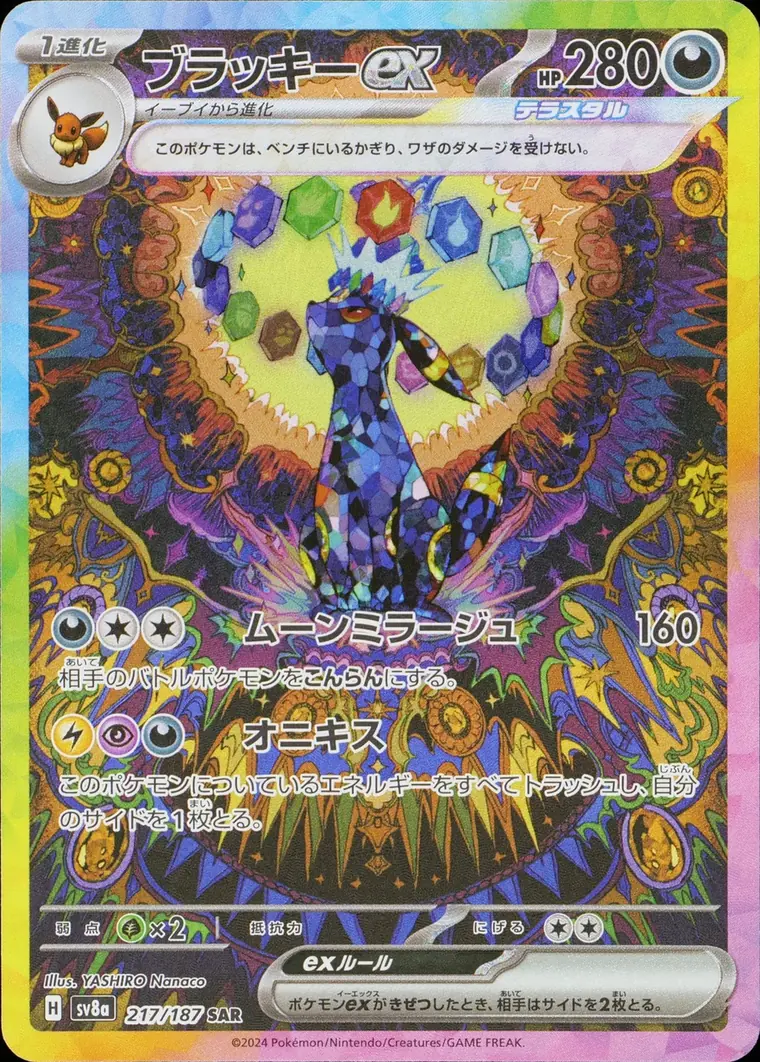
Where to find the set code
The mark in the bottom left, such as "sv8a", is the set code (expansion mark). Type it into the pack name field to choose from suggestions. On cards up to XY BREAK, it is in the bottom right (older cards use a symbol rather than letters).
Choosing the rarity
Rarities in the list include their abbreviation, as in "Special Art Rare(SAR)". Choose the one that matches the abbreviation printed on the card.
If you don't know the set
For old back cards and others you can't find in the list, type the set name manually — just enter what you know.
FAQ
Frequently asked questions
Yes. From the 1996 first set to the latest series, every card is graded to the same standard.
Sorry, we do not grade Carddass or similar cards.
Yes. Select "English" as the card language when you submit.
We grade cards up to 63 × 88 mm and 0.5 mm thick. Jumbo cards and other larger cards cannot be graded.
Unfortunately, we do not grade signed cards.
Yes, through crossover: we remove the card from its slab (PSA, CGC, BGS) and re-grade it at Gemix. The grade may differ from the original.