Yu-Gi-Oh! OCG Card Grading
Yu-Gi-Oh!OCG
27 years since Vol.1 on February 4, 1999. From Series 1 cards to the latest sets, every card is graded on the same four criteria, and the reason behind each grade is recorded in the Grading Report.

- Size
- Small 59 × 86 mm
- Card language
- Japanese, English
- Eligible
- All series, including Series 1 (Carddass and similar not accepted)
- Corner fit
- Available
History
A history of the Yu-Gi-Oh! OCG
From Vol.1 in 1999 to today. The core sets and the moments that shaped the game, by Japanese date (local dates for events abroad).
- 25.1billion+
- Cards sold worldwide (as of March 2011)
- 10,000+
- Unique cards (reached in 2019)
KONAMI and Guinness World Records
01 — 1996–2001
The beginning
The Yu-Gi-Oh! manga begins
Kazuki Takahashi's series starts in Weekly Shōnen Jump (1996 issue 42).
Yu-Gi-Oh! Duel Monsters for Game Boy
KONAMI's video game. 38 of the 40 cards in Vol.1 appeared in it first.
The Game Boy national tournament and Black Luster Soldier
The winner of the Game Boy national tournament received a one-of-a-kind "Black Luster Soldier" prize card.
Vol.1
SeriesKONAMI's Official Card Game begins. 40 cards in four rarities: Normal, Rare, Super and Ultra.
Booster 1
The first of the "Booster" sets: KONAMI OCG cards sold from Carddass vending machines.
Vol.3
The first Effect Monsters and the first Secret Rare ("Gaia the Dragon Champion").
Duelist Legend at Tokyo Dome
Over 40,000 people came. The Game Boy tournament was halted partway, and sales of the venue-exclusive Premium Pack were cancelled.
The Yu-Gi-Oh! Duel Monsters anime
Begins airing on TV Tokyo.
Magic Ruler
SeriesCard numbers (such as MR-01) and the security hologram (Eye of Anubis) appear for the first time.
Thousand Eyes Bible
The first Ultimate Rare, with an embossed relief finish.
02 — 2002–2007
Today’s frame, and the world
English release in North America
The first set, Legend of Blue Eyes White Dragon, was first printed as 1st Edition (Japanese cards have no such mark).
The New Ruler
SeriesCard numbers take the "301-001" form, and the card frame used to this day arrives.
First World Championship
Held in New York.
Soul of the Duelist
SeriesCard numbers gain a language code (SOD-JP001), and the OCG and TCG share the same booster lineup.
The Yu-Gi-Oh! GX anime
Begins airing.
Power of the Duelist
SeriesSet codes grow to four letters (such as POTD), giving card numbers their current form.
Tactical Evolution
The first Holographic Rare, with hologram-style artwork.
03 — 2008–2016
Synchro, Xyz and Pendulum
Starter Deck 2008
SeriesThe Master Rule begins, Synchro Monsters and Tuners arrive, and the Fusion Deck becomes the Extra Deck.
KONAMI runs the TCG directly
KONAMI takes over distribution of the TCG from Upper Deck.
Gold Series
Gold Rares, gilded all the way to the frame, debut in Japan (the TCG introduced them in 2008).
A Guinness World Record
Recognized as the best-selling trading card game, with over 22.5 billion cards as of April 2009.
Starter Deck 2011
SeriesMaster Rule 2, and black-framed Xyz Monsters arrive.
The record is updated
Over 25.1 billion cards as of the end of March 2011.
Collectors Pack: ZEXAL Version
The first rainbow-foil Collector's Rare.
Starter Deck 2014
SeriesMaster Rule 3. Pendulum Monsters arrive, and effect text is numbered ①②.
Duelist Road -Piece of Memory- (Side: Yami Yugi / Side: Yugi Muto)
The hieroglyph-patterned Millennium finish debuts.
World Championship 2015 in Kyoto
Won by a Japanese player, who won again in 2016 to become the first back-to-back champion.
Yu-Gi-Oh! The Dark Side of Dimensions
The film opens in the series' 20th-anniversary year.
Yu-Gi-Oh! Duel Links
The smartphone game launches in Japan.
04 — 2017–2026
Link, and beyond 25 years
Starter Deck 2017
SeriesThe New Master Rule. Link Monsters and the Extra Monster Zone arrive.
Cybernetic Horizon
The first 20th Secret Rare, marking the OCG's 20th anniversary.
The OCG's 20th anniversary
10,000 cards
Ignition Assault takes the card pool past 10,000, with the commemorative "Ten Thousand Dragon" as a 10000 Secret Rare.
Rise of the Duelist
SeriesThe Prismatic Secret Rare arrives, and Ultimate Rares and Holographic Rares get a new finish.
Yu-Gi-Oh! Master Duel
The smartphone version followed on January 27. 100 million downloads were announced in August 2026.
Creator Kazuki Takahashi passes away
Quarter Century Secret Rare
The 25th-anniversary rarity debuts in Rarity Collection -Quarter Century Edition-.
World Championship 2023 in Tokyo
Held at Tokyo Big Sight.
The OCG's 25th anniversary
Marked by the "The Legend of Duelist QUARTER CENTURY" event at Tokyo Dome, starting the day before.
YCSJ Tokyo 2024 sets Guinness records
With 7,443 players, it set two Guinness World Records for trading card game tournaments.
Grand Master Rare debuts
From Limit Over Collection -The Heroes-. Serial-numbered, with 100 copies of each card for Japan.
World Championship 2026 in Tokyo
Held in Ariake, Tokyo.
On older cards, corner and edge whitening and small scratches on foil surfaces are more likely to make the difference between grades.
Knowledge
Collector's Notes
Series 1 cards
Cards from February 1999 to spring 2000 have no card number and no security hologram. "Series" is not an official KONAMI term but a common way to group the core sets.
Reading the card number
In "ROTD-JP001", the set code comes first, then the language (JP is Japanese), then the number. Numbers appeared in 2000 and changed form over time: LB-01, 301-001, SOD-JP001, and today’s four-letter codes.
The hologram in the corner
Added from Magic Ruler in 2000, the Eye of Anubis is an anti-counterfeit feature. It is silver on Japanese cards, and one you can feel as a raised edge is a warning sign.
Telling rarities apart
Look at the name foil (silver for Rare, gold for Ultra, rainbow for Secret), foil artwork, and embossed relief (Ultimate). The same card number can exist in several rarities.
Asian editions
Card numbers with "AE" are Asian-English editions. Japanese-language cards made for other Asian markets sometimes carry "JA", but usually keep "JP", so they can be hard to tell from Japanese cards.
The one-of-a-kind Black Luster Soldier
Awarded to the winner of the Game Boy Yu-Gi-Oh! Duel Monsters national tournament in February 1999. It is different from the 2023 campaign reprint.
How to Submit
Tips for your submission
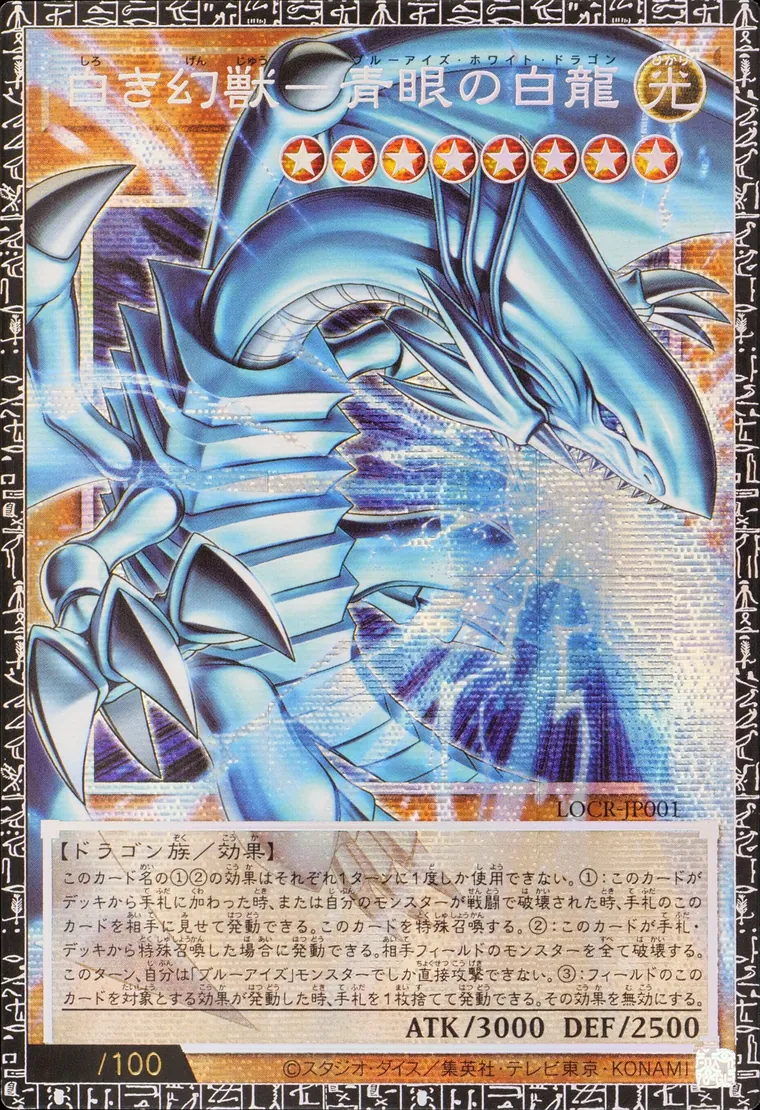
Where to find the card number
The number below the artwork on the right, such as "LOCR-JP001", is the card number, and the letters at the start (LOCR) are the set code. Search the set field by set code or set name. On Pendulum Monsters it is at the bottom left of the card, below the text box, level with ATK/DEF.
Choosing the rarity
Abbreviations such as "SE", "UL", "PSE" and "QCSE" appear in the rarity list by their full names: Secret Rare, Ultimate Rare, Prismatic Secret Rare and Quarter Century Secret Rare. Take care not to mix up UL (Ultimate) and UR (Ultra).
Series 1 cards
These have no card number, so enter the set name (such as Vol.1 or Booster 3) as best you can. If it isn’t in the list, you can type it manually.
FAQ
Frequently Asked Questions
Yes. From Vol.1 in 1999 to the latest sets, every card is graded on the same criteria.
Yes. Select "English" as the card language when you submit.
Yes. Yu-Gi-Oh! OCG cards are 59 × 86 mm, slightly smaller than Pokémon cards (63 × 88 mm). We grade both, up to 0.5 mm thick.
Sorry, we do not grade Carddass or similar cards.
Sorry, we do not grade signed cards.
Yes, with Crossover. We remove the card from the slab (PSA, CGC or BGS) and grade it again at Gemix. Because we grade on our own standards, the grade may differ from the original.